Flying

Posted February 28th, 2008 in Personal, Work by jayshao

(Actually from last night during the flight, but then I got home…)

As part of my new position for CampusEAI I’ve had a fairly aggressive travel schedule over the past few weeks (the cost of not relocating). It has however forced me to become much more closely acquainted with the airlines (and Continental in particular) and prompted a few observations:

  1. Upgrades: Getting upgraded is nice. The biggest problem? Generally people who travel enough to get upgraded are flying on business — and — hence flying at the same time as others flying on business (who fly even more). It’s almost disheartening to watch half the people waiting for the flight standup when they’re boarding Elite Access. Still, it’s nice when it happens.

  2. Delays: So far out of 6 flight segments between Newark (EWR) and Cleveland (CLE) I’ve been delayed 3 times. It doesn’t seem possible to get delayed by less than about an hour either, though so far I’ve been fortunate enough with nothing longer than about 2 1/2. Still, a 50% hit rate is pretty… good? bad?

  3. Airline Clubs: Worth every penny. If you travel a lot. Normally I try to cut my arrival at the airport pretty tight with my flight departure, to grab more time at home with the kids, but during those aforementioned delays… There’s a big difference between an hour delay in the concourse fighting it out with other grumpy bench residents, and an hour delay while sitting in the lounge on the wifi, by the bar, munching on an apple.

  4. Security: Surprisingly I’ve actually gotten used to security — to the point where someone I was traveling with was like “wow — that’s crazy” and my instinctual response was “eh”. Of course, I no longer travel with belts, a watch, coins in my pocket…

  5. Pricing: This is kind of a crazy subject. Right now — a Sun-Wed roundtrip between EWR-CLE is ~ $260. A Sun-Tue roundtrip? ~ $850. Whaaaat!?!?! I’m not sure that there’s any way to explain that other than trying to segment the market into business travelers,since who else would stay less than 3 days? Though, if I book 2 weeks at a time, with 2 weeklong stays that just happen to overlap… hmmm…

In general, business travel (especially regular, sustained travel) has been something to endure. It feels good to vent though :)

Jason’s Employment 2.0

Posted February 17th, 2008 in Personal, Portals, Sakai, Work by jayshao

Well the questions are pouring in (mostly due to my tardiness in writing this kind of announcement) and so, without farther ado…

What Happened?

While it still feels a little strange to say it, as of 2 Fridays ago (2/8) I am no longer employed at Rutgers University. Over the last 9 years as first a student, then staff member, I’ve had the chance to: first study under, and then work with some incredible people. I’ve gotten to watch projects and services grow and evolve into solutions that are used every day by tens of thousands of students, faculty, and staff.

Before addressing my personal situation, I feel the need to speak a bit about the Rutgers Sakai deployment which up until now has occupied so much of my thoughts and energy. I was fortunate enough to see myRutgers grew into a service providing tools and services to every student at Rutgers. Sakai usage is currently somewhere on that curve, with usage growing by leaps and bounds. This Spring’s semester in many ways feels like a qualitative shift in the nature of the service — marked by a huge increase in the number of students asking “where’s my class’s Sakai site.” This semester these questions are particularly significant, as many of them are coming from students in classes where either:

  1. Class was not yet in session. This is a big change from the dynamic in previous semesters where students typically visited the first meeting of their class, and were then directed to visit the Sakai site. Now students are looking to visit the Sakai site to see the syllabus, readings, and get a leg up on going to that first class.
  2. Their instructor had not created a site. Sakai seems poised to make the jump into ubiquity, as in some students minds it’s already there.

Now to handle the really common question — if the Rutgers Sakai deployment is so clearly poised for greatness, where am I going and why? Well…

Starting this past monday (2/11) I have taken a position with the CampusEAI Consortium, where I will be serving as the Director of Open Source Solutions. Recent years have seen a huge upswing in the popularity, and visibility of open and community source solutions in Higher Education. Sakai, uPortal, CAS, Kuali, and othes have garnered attention, awards, and deployments. Due to significant interest expressed by member institutions, CampusEAI is looking to complement its existing strengths on the Oracle platform with broader offerings in the open-source space.

Answers to some personal-ish questions:

Are you moving to Cleveland?

No, I’m going to be based out of NJ, though Continental is certainly getting a good chunk of my time for the next few months as I schlep back and forth.

What does Lisa think?

She’s excited. Well, more excited when I’ve been gone < 2 days as opposed to > 3 days…

What do the kids think?

The kids are still getting used to not picking me up at Rutgers. They think it’s really funny that daddy works somewhere they can’t see. Sunday nights are hard. Phone calls are bittersweet. Coming back is good.

Aren’t you on the JA-SIG Board?

Yes. When my career change became definite I notified the board at the January video call. JA-SIG has always been a community of volunteers (stellar volunteers more often than not) and particular given my new employer’s willingness to continue backing my involvement in JA-SIG it was felt that there were no significant barriers to my continuing to serve in this capacity. As always, JA-SIG

So… is your Rutgers job open?

Yes. Though (see below) I’m hiring too…

What’ll I be doing?

So what does this mean in concrete terms? My personal definition is pretty simple. We’re looking to help members deploy solutions built on open source software. Given my background, Sakai, uPortal, CAS, and maybe even Kuali are obvious possibilities. I think however, that it’s a broader story than just support for deploying a few specific products. Many institutions have experienced challenges in building around open-source due to shortages in staffing or specific skill-sets. Others have successfully deployed open-source solutions, but been burned trying to deepen integration, or due to staff turnover (a problem which I should note also happens around commercial solutions). So the goal of this new unit is to make deploying solutions built on open-source:

  1. Easy
  2. Cost Effective
  3. Low Risk
  4. Sustainable
  5. Did I say easy?

Basically the goal is to allow schools to leverage the strengths inherent in the open-source development model:

  • Try before buy
  • Rational licensing and cost-containment (instead of getting wracked with heavy licensing burdens as you get “too successful”)
  • Open implementations, generally of open standards
  • Economy of scale versus custom developed institution-specific software
  • Freedom from vendor roadmaps and strategy shifts — even to go as far as obtain competitive bids from multiple vendors on the same solutions
  • Peer interaction with really bright people working hard to solve the same problems you see

So that’s the goal. Make open-source easier, removing barriers for schools large & small — the kind of topics that have continually been commented on lists, in journals, and at conferences. Reducing installation pain. Helping with patch management. Providing support and training. Taking the pain and risk out of going open-source, all while working to make strategic contributions to enable the production of more good software.

It should be exciting.

P.S. Did I mention we’re hiring? Drop an email talking about your love for open-source, and how you really want to join in making it easier: jason_shao@campuseai.org. Oh, and mention you saw the posting in my blog ;)

Gainfully Employed

Posted January 26th, 2005 in Personal by jayshao

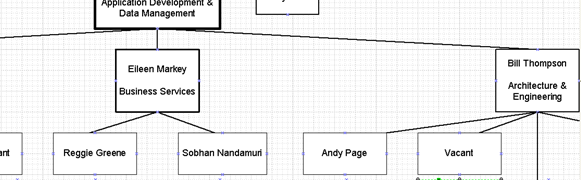
ESS Orgchart

As you can see by the orgchart above, I have accepted an offer of employment from Rutgers University Office of Information Technology. I’m working full-time as of 1/26/2005, and will be working on the myRutgers Portal among other projects. You can see me reporting to the “vacant” box in the lower right hand corner.

Although I was tempted by several other offers, the lifestyle and opportunities at Rutgers ended up being too much to resist. I’m quite impressed both with the quality and direction of the Architecture & Engineering group. Having more time to spend with Christian while also working on my Masters degree was a powerful incentive as well. In the end it just feels like the right place to be.

Outsourcing to… Georgia?

Posted June 11th, 2004 in Commentary by jayshao

The New York Times – New Report Says Outsourcing Causes 9% of U.S. Layoffs

bq.. The bulk of outsourced jobs never leave U.S. shores, the government said on Thursday in a new report suggesting concerns over American workers losing jobs to cheaper foreign labor may be exaggerated.

Nine percent of non-seasonal U.S. layoffs in the first quarter were due to outsourcing, but less than a third of the work was sent overseas, the U.S. Labor Department said in releasing new figures on mass layoffs and outsourcing.

p. This kind of report makes me wonder how much of outsourcing is going to places like Georgia, or North Carolina, and simply reflects the rest of the country catching up to previously cutting edge areas like San Fransisco or Silicon Valley. Perhaps information tech and service jobs are the wave of the future, and some Americans are transitioning from manufacturing and traditional employment into newer fields.

It’s interesting, seeing as these were some of the spots that Sen. John Edwards was campaigning strongest with his anti-outsourcing message. Perhaps America’s rusting manufacturing areas could become the biggest beneficiaries of this new wave of corporate outsourcing.

Unemployment and Offshoring

Posted February 20th, 2004 in Commentary by jayshao

Say I wanted to build a technology research company from scratch. I would hire all of the principal analysts and core management team (including IT) from US sources. All of the accounting, admin, international sales, research associates, call center sales, editorial support, translation services, report production, and IT services would be hired from offshore sources on the cheap. All I need is the talent at the top. How attract great people when the I can’t afford to fund, out of operations or my initial seed money, health insurance and a retirement program for three years or more? I can’t. [ John Robb ]

John Robb’s bit really addresses one of the main reasons that I’ve finally decided to throw in the towel and admit that I’m now more of a Democrat than anything else. The biggest reason for my change is that the Democrats seem to be the only party likely to address serious healthcare reform.

Much media attention has been given to outsourcing and many people have directed hostile attention towards both American Companies and Indian workers for “stealing” good paying American jobs, or the current “jobless recovery.” So many of these complaints focus only on the salary differences between the US and India, when they should be looking at the COST difference between employing an American worker and someone abroad. Because of our employer funded healthcare system, an American’s salary may not be the greatest cost of hiring him.

With many healthcare benefits approaching $600 a worker/month, we’re quickly talking about an additional $8-10,000 a year on top of other benefits. Add in dependent benefits, prescription drugs, etc. combined with our other benefits and we’re easily adding $15-20,000 to every workers salary. This doesn’t even account for providing office space, parking, computers & training, etc.

Imagine the effect that shifting healthcare away from being a per-worker tax would have on employment. Instead of encouraging companies to send jobs oversees to avoid taxes, we’d encourage them to keep them here since they pay for American’s benefits already, and it makes Americans relatively cheaper.

Funny New Employee Handbook

Posted December 11th, 2003 in Commentary by jayshao

Re: DRESS CODE:

It is advised that you come to work dressed according to your salary. If we see you wearing $350 Prada sneakers & carrying a $600 Gucci bag we assume you are doing well financially and therefore you do not need a

raise. If you dress poorly, you need to learn to manage your money better, so that you may buy nicer clothes and therefore you do not need a raise. If you dress in-between, you are right where you need to be and therefore you do not need a raise. Continue Reading »

Robots to Take Over US Economy by 2050?

Posted July 30th, 2003 in Commentary by jayshao

Marshall Brain, the creater of the How Stuff Works website has written a piece discussing his belief that Humanoid Robots will take over the American Economy by 2050. His claim is that advances in robotics will produce humanoid robots that will increasingly replace humans at lower-income jobs due to their lower operating costs, producing millions of unemployed individuals.

I disagree for several reasons:

  1. While greatly appealing to SciFi writers, humanoid robots seem to be less practical than the longstanding trend of building in specific features and intelligence into existing products (e.g. washing machings, vacuums, etc.)
  2. The economy is not a zero-sum game. Massive structural changes tend to create shifts in labor, not persistant unemployment.
  3. I think Marshall greatly underestimates the complexity of solving fundamental AI/sensory perception issues for robots. (similar to underestimation of the complexity of voice recognition software)

Continue Reading »