[Fixed] Ubuntu 9.10 & Compiz Breaks VNC

Posted February 16th, 2010 in ContextWeb by jayshao

So, found out while trying to VNC into my work box, that the “Visual Effects” in Ubuntu breaks the built-in GNOME VNC server – what happens is you can input text, click on controls, but changes are not refreshed into the view (the view isn’t “Damaged”). The current workaround seems to be either moving back to Metacity or some other WM, or turning off visual effects.

Side Note: Jolly’s Fast VNC is an AWESOME VNC client – as it suggests, fast, and with a really cool zoom mode for handling well larger screens over VNC, much recommended (after you fix the compositing ;) )

Google releases Wave protocol implementation source code – Ars Technica

Posted July 28th, 2009 in Commentary by jayshao

Google releases Wave protocol implementation source code – Ars Technica: “At the Google I/O conference earlier this year, the search giant revealed an intriguing new communication service called Wave that aims to deliver concurrent messaging and collaborative editing in a single cohesive environment. The underlying Wave Federation Protocol is designed to make it possible for third parties to host their own interoperable Wave instances. Google intends to open the source code of its own implementation in order to encourage widespread adoption of the protocol. The company took its first major steps in that direction on Friday by releasing the source code of its Operational Transform (OT) code and a simple client/server reference implementation that is built on top of the protocol. This code, which is available under the open source Apache Software License, will give developers a way to start experimenting with the protocol and potentially even building their own Wave-compatible services.”

(Via http://arstechnica.com.)

I hate to hop on the bandwagon, but I have to admit – Wave looks like the most revolutionary item I’ve seen in a while – in a full-on game changer sense. Not so much just because of the cool widgetry that Google’s built, but because it’s a protocol – with the flexibility and potential that implies.

Building on some of the interactions we’ve seen with IM, Blogging/Trackbacks, Twitter, and other messaging, Wave looks to standardize, federate, and embed real-time, multiparty communications to the point where it will become part of the fabric of the web. If Web 2.0 = comments and trackback conversations – this feels a lot more like Web 2.5 – the implementation we really wanted when we first tried to take the web from a document-based publishing platform to a conversation-enabled collaborative medium.

And… Open-Source production-quality reference implementation – what could be better. I have to say, not an small number of my off-work hours are going to be spent looking at embedding Wave into… everything… Particularly given that Federation (though still a little nebulous) is a first-class citizen in the platform.

Hudson Radiator View

Posted July 10th, 2009 in Commentary by jayshao

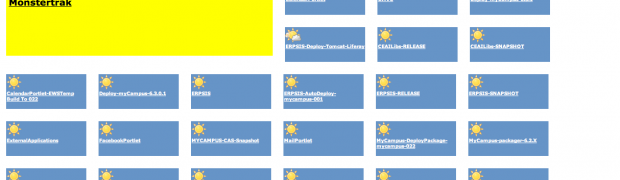
This is cool – recently enabled a Radiator view on Hudson, which gives you a quick at-a-glance build status array for display as extreme feedback on a wall or chart — seems particularly useful for distributed or distance teams if you’re willing to plug in a couple extra monitors to give them a huddle-room feel.

hudson radiator view

CoolIris nee Piclens

Posted March 22nd, 2009 in Commentary by jayshao

Just updated their Safari plugin – seems to work great in Safari 4.0 Beta. Also added a nifty embedded flash viewer that has lots of the same visualizations and whatnot.

This is pretty cool – I may have to replace my default Flickr photo bit with this…

Dominos Gets Actionable Intelligence

Posted March 14th, 2008 in Commentary by jayshao

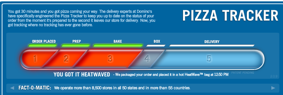
So I was ordering a pizza today from Dominos (been a while, but being car-less around lunch tends to limit options) and noticed that they have just about the coolest web feedback system for an order I’ve seen:

dominos-tracker-1.png

So, not only can I see an estimated delivery time, but if I leave the browser open (which of course jugar seguro portales internetjuegos portal internetruleta americana portalescasino ruleta gratisruleta americana onlinejugar ruleta onlineruleta pagina webtragaperras internetmaquina tragaperras portal webjuego tragamonedas,jugar tragaperras,jugar tragamonedas webjugar gratis onlinecasinos virtuales portalesapuesta dinero internetcasinos virtuales onlineganar premio internetganar dinero real portales webjugar seguro pagina webharveys casino hoteljuego paginas internetvideo poker webpremios internetjugar ruleta de la fortunaonline casino betrugslots comkasino on netvirtual kasinoswww online casinoswiss online casinocasinospiele mit echtem geldbaccarat spielewww roulette detop internet casinoroulette gratis spielenroulette lernenonline kenocasino bestcasino on net deroulette online gameskasino im internetkostenlose casino onlinecasino online und poker portalwww casino on net comonline casino österreicheinarmiger banditspielkasino onlineblackjack spieleinternet casinoscasino comtop kasinopc slots I did) you can watch it getting updated in realtime.

dominos-tracker-2.png

I assume there’s some kind of time tracking system in the kitchen that they’re using and some clever soul said (hey, we could broadcast this data to our customers). In any event, my pizza’s in the box, the delivery guy (Jian) left the store at 12:52, and I’m feeling hungry.

Pop!Casts: Adrian Bowyer

Posted January 9th, 2008 in Commentary by jayshao

<

p>Pop!Casts:

<

p>

A machine that builds itself? Adrian Bowyer, leading researcher at the University of Bath, shows us that this seemingly fantastic idea is not far from becoming reality. The self-replicating rapid prototyper, or “RepRap,” could have dramatic effects on people in developing countries.

(Via The Pirates Dilemma.)

The thought of being able to take any design, and automatically cottage-industry manufacture it for the cost of materials & time feels unbelievably transformative. The possibility of bootstrapping this with a self-replicating machine…

I wonder if IKEA will be the first people to figure out how to let us print out their product at home… though being able to reprint a replacement screw/gasket/washer even if I have to run to the hardware store would be sweet.

Back on PlanetSakai

Posted December 20th, 2007 in Sakai by jayshao

Should be showing up on planetsakai.org again. Guess my URLs aren’t cool, since they changed…

SakaiCon Recap

Posted December 8th, 2007 in Sakai, Work by jayshao

Sitting on a flight, returning from the Sakai conference — still trying to take everything in. There’ll probably be more musing on the significance of specific items coming up, but things that struck me enough to want to brain dump were:

  • There was wide consensus during the planning sessions that there’s a desire to focus on quality: reliability, testing, performance, and other traits, over new feature development.
  • The community is moving from a development -> production mindset. The transition of many of the core schools from pilots or development efforts into full-blown production instances has certainly changed priorities and outlooks.
  • Increased desire to pick up open-standards in preference to inventing our own. JSR-168 (Unicon demoed a cool Portlet-Tool for Elluminate integration), JSR-170 and the good work Ian is doing to integrate with repositories like Jackrabbit and Xythos, CAS Authentication (vis-a-vis Dan M.’s sweet CAS-embedding UserDirectoryProvider)
  • There’s a lot of commercial activity around Sakai. RSmart, Unicon, Oracle, IBM, bit players like Mark Norton & Zack Thomas. I sat in a presentation about the work I did with FIDM for CampusEAI. I even talked with another developer who has already resigned (as of Jan 1) from his university to join his part-time venture (with others) full-time. Certainly a large, vibrant marketplace.
  • Many sub-groups are organizing around Sakai. In addition to our very own NYC Regional group, there are groups in California, Australia, the Netherlands, and other places. They’re holding events, sponsoring training, and moving forward.
  • It’s not just regions — there are an increasing number of functionally aligned teams. Developers, Designers, and Managers are the best organized and served. I also saw a lot of User Support people or academic technologists as well. This is the group I suspect may be the next to organize — a CAFE track focused on bringing user support people up to speed or sharing experiences/resources would probably be really valuable.
  • Lots of parallel activities. Many examples of SIS integrations, library integrations, documentation & training, tool development. Unfortunately, communication barriers and other difficulties seem to be producing several duplicate/parallel efforts (e.g. Yale’s SignUp tool, EDIA’s signup tool, Stanford’s efforts around this space) though there is a desire to collaborate.
  • Some stuff is still too hard: authentication integration, CourseManagement integration, libraries work, documentation, training are all pain points, especially for smaller teams/schools.
  • Strong community. It’s easy to get lost in a group of smart, affable people moving towards a common purpose. Had an excellent time, and there’s a good sense of camaraderie weaving throughout the community. People are friendly and helpful.
  • Twitter – yeah, it’s kind of narcissistic, but at an event or convention it can certainly be a lot of fun. Both to do self-organizing (e.g. dinner?) and to pull in people who are in the circle, but not present.

JA-SIG Conference: Future of Identity Management in HigherEd

Posted June 26th, 2007 in Identity by jayshao

Jens’s talk is focusing on Identity Management where he’s focusing on life-cycle of identity data. Looks like the talk is going to focus on moving towards user-centered identity.”Access to the right resources, to the right users, at the right time” — focused on providing, not preventing access (e.g. from a security perspective).

Authentication vs. Authorization is an important distinction which as an industry we’ve definitely treated sloppily. The delegation scenario (e.g. Kim Cameron’s many writings on the topic) is also very interesting, as “acting on behalf of” really is such a core capability that we often lose when we move into the electronic realm.

Lessons:

  • Identity is about relationships – (especially) university ones change over time
  • Multiple authoritative sources – authorities for attributes, not people
  • Separating account names from stored account ids
  • Dynamic rules instead of static roles – interesting in how that pattern’s been modeled in the uPortal community via the adoption of PAGS groups over statically defined ones…

Interestingly, Jens (also in previous conversations) does believe that Federation has some low-hanging fruit and is worthwhile, at least in the short run. I’m still not sure — though he made a very good distinction in the amount of work necessary for IdP vs. SP participation. Shibboleth… one of the key distinctions that Jens is making for the federation case is that Shib maybe more appropriate for federation requirements with generalized, lightweight access where you have similar rules across all members – e.g. all members can access protected library resources.

TurnItIn, iTunesU, JSTOR are on Jens’s list of shibboleth providers and products, which is a pretty attractive list. Not sure what kind of federation agreements have to be in place for these various resources.eduRoam is neat looking — ability to login to another institution’s wifi would be cool.

Identity 2.0: now we’re talking! Claims based — the comment Jens made about University-centric identity assuming that institutional relationships are the most important relationships people have, but that’s not how users are likely to see it seems quite apropos. Claims combined with self vs. 3rd-party verification in a mixed-model really is a neat model for thinking about identity data, and does seem to match the real-world situation well.

The privacy angle of not requiring the IdP to process the transactions, and hence possibly have access to what I’m doing is something that doesn’t seem to get talked about in the US as much, but as more things move online does seem key.OpenID — where we’re seeing convergence in the identity space. CardSpace is also a key player. OpenID support in CAS really seems to make it well positioned to participate in this space.

Conclusion: not sure I’m sold on Federation as the low-hanging fruit, but some of the Shib enabled services do seem pretty compelling. User-centric definitely looks like it’s gaining steam though, which is definitely exciting. This definitely seems to be an area where Higher Education should be at the forefront, since our it is one of the few areas where Higher Education does seem to have legitimately more complex needs and requirements.

Facebook Platform – In-road to HE Legitimacy?

Posted May 25th, 2007 in Portals by jayshao

http://developers.facebook.com/index.php

facebook-platform.png

Facebook has once again made it the coolest platform ever by opening their API further, and most importantly supporting sessions that don’t expire every 24 hours. There’s been a lot of talk on the web about this helping them to monetize Facebook’s user base through commerce partnerships. I think that’s true, but I also think it’ll have a profound affect on Facebook’s traditional market — college students.

The breadth and volume of Facebook’s usage on college campuses is hard to ignore. In a focus group I had with our career center, a number of students told me that Facebook was basically their primary method of communications. It’s how people share photos, find study partners, blog, and watch their friends all rolled up in one.

I think the key of the new platform initiative is that integrations like Duke University’s DukePass portal integration that drive Facebook into the heart of institutional IT initiatives. There’s just too many users, and it does stuff too well.

So not only is Facebook broadening their reach — they’re also tightening their ties to their core audience. And the possibility to actually partner with institutions, as opposed to having to grassroots everywhere. Bottom line — smooth move.