“Sakai Courseware Management” – *the* Sakai Book

Posted August 2nd, 2009 in Sakai by jayshao

This may be old news to others, but I finally have my copy of the new “Sakai Courseware Management” book (courtesy of the folks over at Packt) and more surprisingly have even been able to carve out time to read the contents. For people who may not have been aware, this is the book that Alan Berg & Michael Korkuska have spent the last many months of their lives churning out.

After looking through “Sakai Courseware Management”, I’d say if you’re a technical staff member working with Sakai it’d be invaluable. Finally, much of the community knowledge and resources have been distilled into a single volume, greatly shortening the learning curve — and with enough topics that even old-Sakai hands will likely see some new bits, courtesy of the deep knowledge of Alan & Michael.

Continue Reading »

Maven, Tools.jar, and Macs

Posted July 10th, 2009 in Commentary by jayshao

On the Mac, was using some maven build scripts (well, ANT wrapped in Maven) recently that had references to tools.jar. This is problematical on the mac, since Apple repackages tools.jar (some bits go in Classes.jar) and ironic since some of the classes are already available, so it’s an unecessary error. Some digging revealed a recipe for using profiles to fix this:

https://jira.jboss.org/jira/browse/JASSIST-44

OSP ePortfolios & Sakai Courseware?

Posted April 27th, 2008 in Sakai by jayshao

I started this entry while I was riding a train back from the Laguardia ePortfolio Conference I’m endeavoring to reflect upon and synthesize threads from various (enlightening) presentations I’ve seen, and discussions I’ve had the privilege of participating in. First a brief plug: the content from the conference was fantastic — many congratulations to the folks from Laguardia Community College for organizing such a wonderful event.

Sakai has amazingly broad potential. The energy and excitement in the community and among those who have been watching Sakai make it clear that we’re really realizing the benefit of contributor’s blood, sweat, and tears in the form of some exciting tools for teaching and learning. Sakai seems uniquely positioned to become the base of a whole ecosystem of tools supporting different facets of the academic experience ranging from instruction, to assessment, to facilitating interactions between learners. I think we may be at a crossroads in terms of positioning, particular as we evolve towards explaining the product, beyond the project & community. Laguardia’s conference and discussions, especially those related to “Sakai vs. OSP” really focused my thinking on various opportunities for Sakai to support different areas of teaching, and learning.

A statement: I think the the common usage of Sakai to discuss both a specific set of tools supporting course/learning management (Sakai CMS/LMS?) and a platform/environment upon which those tools can be built and deployed has resulted in some confusion. I have heard many questions recently in the vein of “do you have to use Sakai to use OSP?” or “we’re a Blackboard school, and aren’t going to switch, does that mean OSP is out?” The fact that OSP is a toolkit built on top of Sakai (the platform) seems to be a confusing point for many who don’t currently have plans to deploy Sakai as a CMS/LMS.

To clarify, yes: it is quite reasonable to deploy OSP as a system exclusively dedicated to portfolios, completely separate from the other tools. Inputting text, adding reflections, uploading evidences, and managing assessment are all perfectly capable of being performed in a stand-alone environment. In the same way that past releases of Sakai downloaded from sakaiproject.org “stealthed” (hid) the portfolio tools an institution could choose to leverage the OSP piece of the Sakai ecosystem without forcing your users to adopt the entire environment — one advantage of the platform’s open-ness and customization capabilities.

In fact, I think this scenario illustrates a very real way to explain Sakai. If Sakai is a platform upon which bundles of tools (courseware, OSP, etc.) can be built, then we have a product with many facets. Each facet (LMS, OSP, Collaboration) supports a different interaction scenario, part of a greater whole of learning. Going forward, perhaps explicitly separating that greater platform from its concrete manifestations (particularly as courseware) would help emphasize Sakai’s potential as a learning suite or system — with facets focused on all aspects of a learner’s experience: courses, co-curricular’s, career advising, libraries & research, collaboration, and personal expression for a start. This thinking was really influenced by listening to many people talk about OSP — as a toolkit for building concrete artifacts: resumes, co-curricular transcripts, certification documents, personal expressions — all leveraging the same tools, but in many respects separate endeavors linked only by

I think there’s a danger that we could allow ourselves to slot Sakai into a box defined by the products that came before. though that’s where many adoptors initial exposure came from. The example of OSP illustrates the clear potential of Sakai’s modular architecture to enable assemblage of higher-level environments supporting particular styles of teaching or interaction. A common environment lets us both build on previous work, and also focus on integrating the experiences for out students and teachers, participants and leaders. My programmer’s mind sees this as being much the same potential as is now playing out in the Eclipse eco-system.

So the question I think this brings up is: if we focus on this broader picture, and think about these “bundles” as being the real deliverable, could we better frame this relationship by rebranding (consistent with recent thoughts about relaunching) the Sakai courseware tools as a separate entity within the Sakai umbrella — “Sakai Classrooms” maybe? Leaving room for thinking of the ecosystem as bundles, which you can mix and match: “Sakai Portfolios”, “Sakai Communities”, “Sakai Social Networking”. Different bundles of functionality built on the same platform, possibly using the same individual tools, but illustrating some of the broader possibilities.

Dominos Gets Actionable Intelligence

Posted March 14th, 2008 in Commentary by jayshao

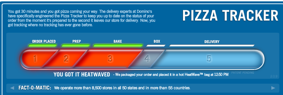
So I was ordering a pizza today from Dominos (been a while, but being car-less around lunch tends to limit options) and noticed that they have just about the coolest web feedback system for an order I’ve seen:

dominos-tracker-1.png

So, not only can I see an estimated delivery time, but if I leave the browser open (which of course jugar seguro portales internetjuegos portal internetruleta americana portalescasino ruleta gratisruleta americana onlinejugar ruleta onlineruleta pagina webtragaperras internetmaquina tragaperras portal webjuego tragamonedas,jugar tragaperras,jugar tragamonedas webjugar gratis onlinecasinos virtuales portalesapuesta dinero internetcasinos virtuales onlineganar premio internetganar dinero real portales webjugar seguro pagina webharveys casino hoteljuego paginas internetvideo poker webpremios internetjugar ruleta de la fortunaonline casino betrugslots comkasino on netvirtual kasinoswww online casinoswiss online casinocasinospiele mit echtem geldbaccarat spielewww roulette detop internet casinoroulette gratis spielenroulette lernenonline kenocasino bestcasino on net deroulette online gameskasino im internetkostenlose casino onlinecasino online und poker portalwww casino on net comonline casino österreicheinarmiger banditspielkasino onlineblackjack spieleinternet casinoscasino comtop kasinopc slots I did) you can watch it getting updated in realtime.

dominos-tracker-2.png

I assume there’s some kind of time tracking system in the kitchen that they’re using and some clever soul said (hey, we could broadcast this data to our customers). In any event, my pizza’s in the box, the delivery guy (Jian) left the store at 12:52, and I’m feeling hungry.

JA-SIG Unconf: Recap

Posted November 18th, 2007 in Portals by jayshao

So, the JA-SIG un-conference (even the working sessions) is over, giving me a chance to do some thinking and reflection about the event and its aftermath.

Overall, the attendance, interest, and excitement demonstrated by all of the participants was pretty overwhelming. We had both more individuals, institutions, and organizations represented than we ever would have anticipated for an inaugural event. Even JA-SIG product deployers like Collier from UMBC and FLUID were well represented. While everyone undoubtedly came away from the event with different thoughts, two items struck me as particularly exciting.

MyUMBC

Collier demonstrated the MyUMBC work he’s been doing. While not uPortal based, the reactions related to the functionality of his portal ranged from “wow, I want it” to “you built that yourself?” to “don’t show that to my users or they’ll want it.” A couple of thoughts on why everyone in attendance found Collier’s work so compelling:

  • Presentation: Collier threw away the assumption a portal must allow users to add/remove/re-arrange content. This dramatically simplified his problem domain, and allows him to capitalize on web-design techniques to tune his layout and presentation.
  • Focus: MyUMBC is focused on end-user tools, not building frameworks. While in many portal project 75% of the time seems to be spent bringing up the platform, and making changes there, Collier spent 75% of his time building tools for news, events, favorites, etc.
  • Integration: MyUMBC has a number of tools and concepts that serve to knit the experience together — the favorite stars, the dashboard on the start page, navigation cues all make the experience feel integrated
  • Feedback & Monitoring: MyUMBC built a feedback system integrated into every page, and a lightweight dashboard to extract key statistics from that system. As a result, feedback is easy (~6000 in less than 6 months) and mining the data for trends is also correspondingly easy. This combined with standard tools like Google Analytics support a nice feedback-response loop while requiring minimal custom tooling.

Portlets

JA-SIG and uPortal have always been very focused on building out uPortal as a portal Framework. A consistent thread throughout the un-conference however (partly sparked by MyUMBC) is a bubbling thread of focusing on portlets and tools. I think there’s a growing recognition in the community that the tools are what users are visiting a portal for in the first place — and an area we have not focused as much attention on in the past.

In particular, collaborative efforts in the portlet space received a lot of discussion at several different sessions. LMS, SIS, Library, and other areas all seem to be places where schools have repeatedly re-invented the wheel. Collier’s demonstration of the return from focusing on tools, and the timing related to the talk on JA-SIG project incubation I think have all contributed to an atmosphere where people are highly interested in collaborating higher up the stack.

EDUCAUSE Community Source Reception

Posted October 31st, 2007 in Portals, Sakai by jayshao

At the Community Source reception cosponsored by JA-SIG, Sakai, Kuali it was uplifting to see the number of people participating. CIOs, managers, developers, vendors were all present in abundance. It was also clear from conversation at the reception that open-source in the Higher Ed is breaking into new areas. While there’s no question infrastructure and back-end systems, there’s increasing acknowledgment that open-source might has a role to play in end-user facing systems too. community driven open-source projects are being evaluated right along side best of breed solutions from vendors or ASP providers.

In fact, further than just being considered on par with packaged or commercial products, many, many people have indicated the message of “by Higher Education, for Higher Education” really resonates both within IT as well as with our end users. Ranging from solid support for integration with existing systems in uPortal, to teaching and learning as evidenced by the comment “It seems like EDUCAUSE is all Sakai” show a tremendous amount of attention and consideration being given for education build open-source solutions.

Sakai Conference: Portal Options

Posted June 12th, 2007 in Sakai by jayshao

Chuck Sev. is doing a demo of some of the new features that have been ported into Charon Portal in trunk. Additional hooks in Ian’s new portal Impl support multiple Velocity

Features

  • Hierarchy – sub sites, NO INHERITED AUTHORIZATION, velocity templated
  • Single Tool View – edit Page order, and the toolbar/nav disappears so that you’re focused on only one tool — e.g. wiki, others. Also playing with using a iFrame tool, and point at another Sakai instance, inside the iFrame.
  • Display icons for tools
  • **iFrame-free View
  • Size features detection

ToDo:

  • Federated
  • OSP Convergence
  • WSRP Producer
  • Sakai-Portlets
  • iFrame Replacements
  • Nav
  • Portable Portlets
  • iFrame Replacement
  • WebProxy

Portal Implementation

Various API’s and influences provided for extension points — RenderEngine, Providers other pieces. Should support hot-loading from WAR/JAR files, or in the VTL. PortalHandle can be implemented to do URL handling and other pieces.

OSP Portal

  • Sites grouped by site type – e.g. courses, projects, semester? (IU)
  • Tools in categories – collaboration/communication/admin? Also, the OSP portal changes allow things like contextual help/descriptions. I wonder if this might be an answer to our teaching pedagogy focused help — maybe the help becomes embedded in the tool selection screen.
  • Tools hidden based on permissions – site-editor hiding usage scenario
  • Breadcrumbs -
  • Category screen w/XHTML templates
  • Portable rendering skin-able by XSLT

Plans to bring the portal forks (Velocity, OSP, etc) back together… using Ian’s pluggable extensions points — targeted for 2. 5

One concern I would have about the variety of portal “skins” using different templating engines is that it seems likely to produce forking in terms of CSS and designs, making it harder to share design elements across sites.

Sakai Conference: Content Hosting & Resources

Posted June 11th, 2007 in Sakai by jayshao

Ian’s talking about plug-able back-end implementations for ContentHosting and the Resources tool. Looks like a VFS type layer that should support adding arbitrary backing stores – the example he gave was DSpace, but people are talking about other stores like AFS, iTunes, etc.

One of the comments that’s come up during the discussion is how do you integrate various backing stores disparate permission models, capabilities, etc. Translating things like ACLs, metadata, etc. into different backing stores seems problematical. Possibly some kind of UI extension point supporting store specific interfaces is being discussed asa possible solution.

SCORM implemented a Zip file handler, allows you to navigate, serve out, etc. Seems to be the defacto example of how to write a ContentHostingHandler.

Hmmm… Customizing the Resources tool – talking about ways to define custom behaviors within the Resources tool/FilePicker, and others. OSP, Citations, SCORM, others. ResourcesType = allows people to define actions supported by a resource, labels, icons, metadata, others. Types are loaded at startup and added to a ResourceTypeRegistry.

<break></break>

Code-walk through of various classes and interfaces for implementing Handlers. Also talk about OSP integration, and how that was done to integrate Forms with Resources. Since the example OSP providers were written, it sounds like some base/helper classes have been created to streamline the process of writing types, springifying them, etc.

Citations looks like an interesting tool. Dumping citations & references into Sakai seems like a reasonable use, piggybacking on resources might enable interesting capabilities like shared citation lists and others to be relatively simple. This feature screams for a JS book-marklet to “cite this” from your browser toolbar.

Talks about API changes for 2.5 – some thoughts about types of data to pass back, and the value of returning references vs. full-blown entities. How to set the types for say files uploaded via WebDAV — callback?

ongoing · OpenID at Work

Posted May 9th, 2007 in Identity by jayshao

ongoing · OpenID at Work – This caused a GIGANTIC thread on the identity-gang list that got back to the question of implicit authorization off of an authentication source. I know when I was looking at Rutgers IdM infrastructure, assumptions about what having a credential meant was a serious barrier to then expanding issuing of credentials/access to a wide variety of useful groups (prospective students, alumni, parents…)

YouTube Obeys Fake Takedown Request From 15 Year Old

Posted April 15th, 2007 in Commentary by jayshao
YouTube Obeys Fake Takedown Request From 15 Year Old : “Want a video removed from YouTube? Send along a fake takedown notice pretending to be from the copyright holder. At least, it’s a prank that worked for a 15 year old from Perth, Australia, who sent a signed form to YouTube pretending to be from the Australian Broadcasting Company. The form requested the takedown of hundreds of clips from ‘The Chaser’s War on Everything’.”

(Via Mashable.)

I have to admit that I can understand how this would happen.

  1. Given both the lack of authenticity you see in a lot of genuine communications from Banks or companies (that come from only an IP address, or some internal server, etc.) and the general difficulty of verifying identity online.
  2. The current litigious atmosphere in business in general makes it hard to argue for erring on the side of not taking every incoming item carefully. Afterall, if you were a junior-ish person processing these requests, would you like to go on the line if it meant possibly being held responsible for exposing the company to a lawsuit?